

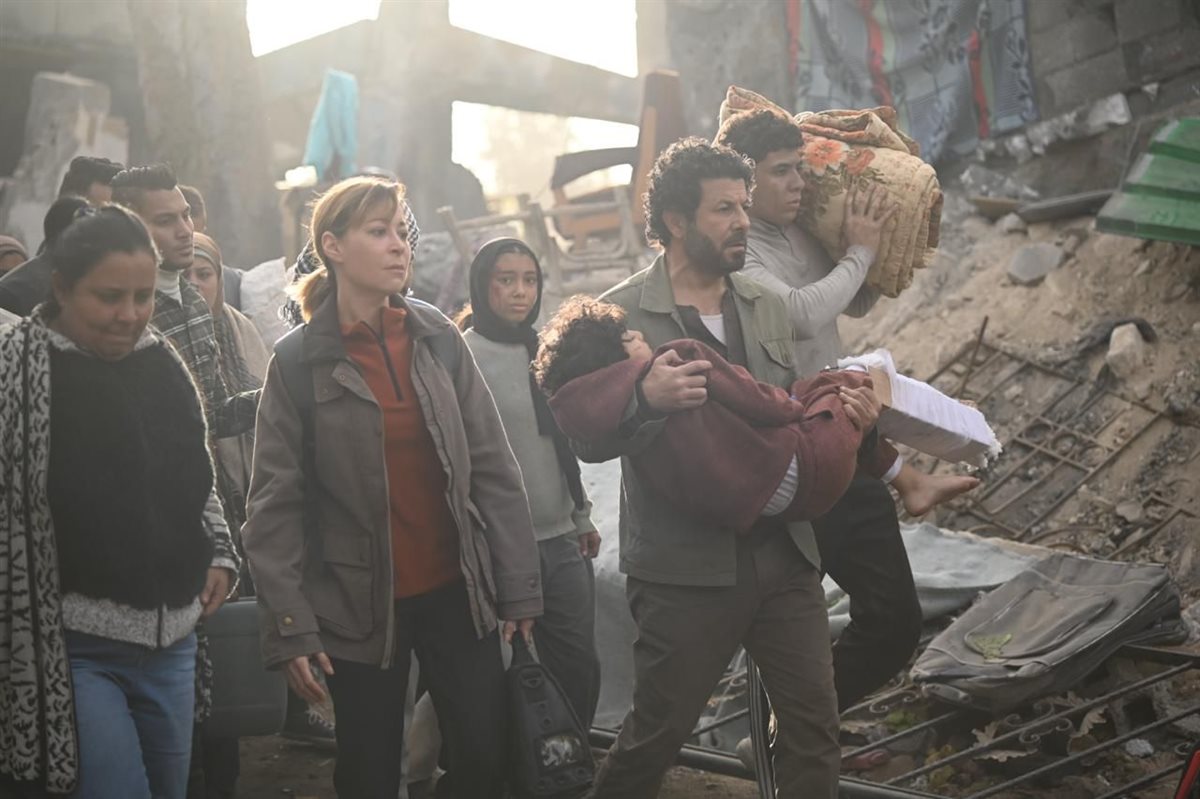
Eyad Nassar affirmed that the series “Sahab Al-Ard” (The People of the Land) is among the television works that most accurately portrayed the Palestinian cause and the resilience and heroism of the Palestinian people.
During his appearance on the program “One of the People” with journalist Amr El-Leithy, he pointed out that the series successfully documented the extent of the destruction and suffering endured by the residents of the Gaza Strip during periods of war.
The Palestinian people love life
He added that the message of the work was to highlight the Palestinian people’s love for life and their pursuit of living despite the harsh conditions, which was clearly embodied through the events of the series, noting that the preparations were at a high level, with huge production capabilities, with great attention to all details, especially the decorations that accurately reflected the nature of the events and the tragedy of the Palestinian people.
Regarding the final documentary-style episode, he explained that it depicted attempts to rescue children and give them hope for a new life, emphasizing that the struggle continues and that the Palestinian people will remain steadfast on their land until they return to it.
Iyad Nassar praised Egypt’s role during the war on Gaza, noting the efforts made to support and assist the Palestinian people in various ways.
He added that he holds Jordanian citizenship and has Palestinian roots, which has allowed him to experience the suffering of the Palestinian people, especially in the Gaza Strip, throughout his life.
Regarding his participation in the series, he revealed that he had been preparing for another dramatic role but declined it immediately after reading the script for “Sahab Al-Ard” (The People of the Land) due to the importance of the idea and the strength of the subject matter.
The series stars Menna Shalaby, Iyad Nassar, Palestinian actor Kamel El Basha, Essam El Sakka, and Tara Abboud. The script and dialogue for “Sahab Al-Ard” were adapted by Ammar Sabry, with script and dialogue development by Mohamed Hesham Abeya, and directed by Peter Mimi.
