



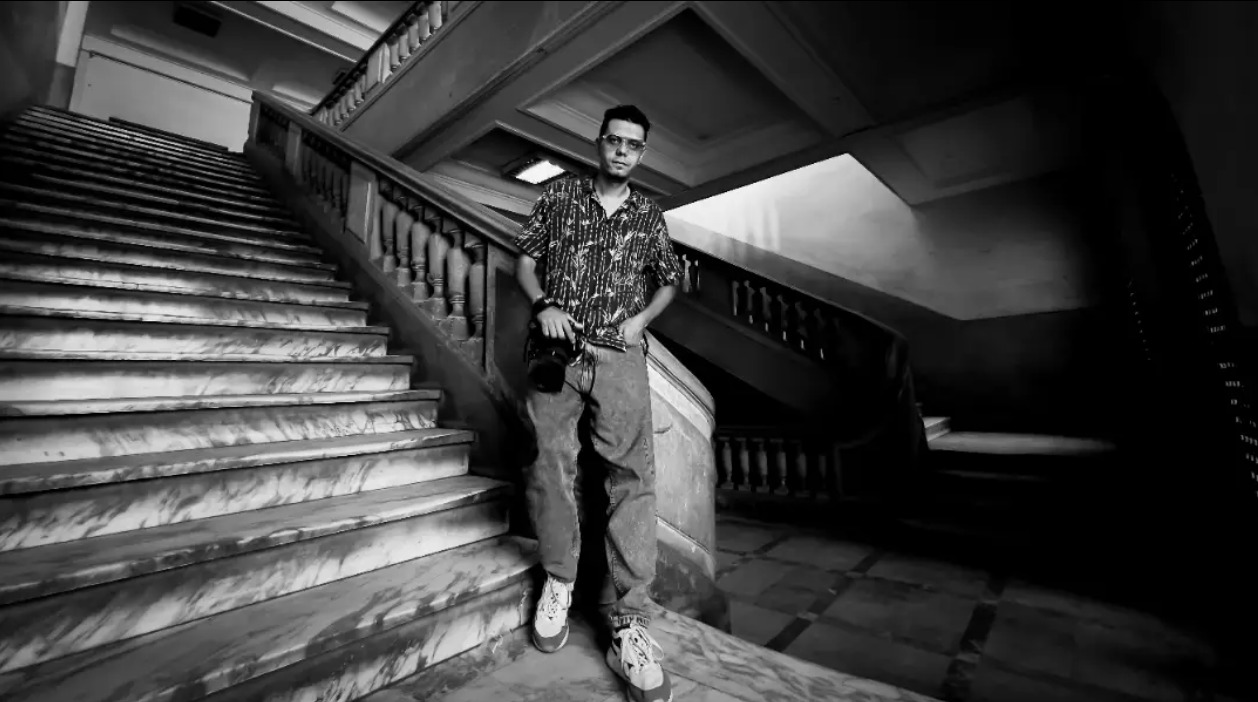
Shady El-Fahham is one of the most prominent names in cinematography in Egypt, boasting over twenty years of experience behind the scenes of the film industry. He particularly distinguished himself in behind-the-scenes photography for the BTS films, capturing authentic and human moments on set and offering audiences a unique perspective on cinema rarely seen on screen.
He has participated in numerous successful films, including “Badal Faqed,” “El Maslaha,” the three “Welad Rizk” installments, “Siko Siko,” “Bank El Haz,” and “Darwish.” He has also appeared in television dramas such as “Ard Wa Talab,” “Welad El Shams,” “Zolm El Mastaba,” “El Zaibaq,” “Wesh Tani,” and “Taht El Wasaya.”
Although his beginnings were far removed from this field—he studied commerce—his passion for cinema led him to completely change his career path, making him one of the leading specialists in this type of cinematography. His presence wasn’t limited to film sets; it extended to social media, where he successfully built a large following by sharing behind-the-scenes glimpses of his work and experiences, becoming an influential content creator and an inspiration to many young people.
To shed light on his career and experience behind the scenes of film and content creation, we conducted an exclusive interview with photographer and cinematographer Shadi Al-Fahham, who is also a social media content creator. During the interview, he shared his journey in the world of photography, his most prominent works, his perspective on the difference between fine art photography and cinematography, and the most significant challenges he faced throughout his career.
What is the real difference between a regular photographer and a cinematographer?
A regular photographer seeks the aesthetics of the image, whether in portraiture, weddings, or events. Their primary goal is client satisfaction and capturing a beautiful moment.
The cinematographer, however, has a completely different objective. They strive to capture the “dream” or overall mood of the film by taking images that reflect the work’s atmosphere and are suitable for use in social media promotion, while ensuring the lighting aligns with the director of photography’s vision.
This is why the cinematographer is often called the “unsung hero” on set, given their crucial role in delivering iconic images that significantly contribute to promoting the film.
How was your experience working on the film “The Cell”?
It was one of the most challenging experiences I’ve had, especially working with such a large team that included actors Ahmed Ezz and Mohamed Mamdouh, director Tarek El-Erian, and director of photography Mazen El-Metgawel. It was essential to concentrate intensely while following the director’s instructions to understand how to execute each shot and achieve the best possible image.
The film’s difficulty stemmed from the numerous action scenes, particularly those depicting the security forces storming terrorist hideouts, which included explosions, gunfire, and bombs. These scenes were filmed at night during winter, in harsh weather conditions, but ultimately, we succeeded in delivering the scenes as required.
Are there actors who are easier or more difficult to work with during filming?
I’ve worked with a large number of actors, and the vast majority are very easy to film. However, there’s a small percentage, no more than 20%, who are relatively more challenging to work with, either because they need to concentrate intensely during the scene, or because the presence of the camera can cause them some distraction.
Actor Ahmed Ezz is one of the actors I’ve most enjoyed working with, especially since our collaboration spans nearly 19 years. During that time, we’ve collaborated on projects like “Badal Faqed,” “El Maslaha,” and the “Welad Rizk” series, in addition to preparing for a short film titled “Akhoya” directed by Sandra Nashaat.
I’ve also enjoyed working with a large number of other actors, including Asser Yassin, Amr Youssef, Essam Omar, Ali Sobhi, Taha El Desouky, Salma Abu Deif, and Mona Zaki.
Did the internet play a role in building your career in this field?
The internet is an important tool, but it wasn’t the foundation of my career. Whether it existed or not, I would have continued working in photography. However, its advantage lies in allowing a wider audience to see my work, which contributes to broadening my reach.
Has technology made the work easier or made the competition more difficult?
Technology is a tool that must be kept up with and utilized, but it hasn’t directly made the work easier or harder. The most important factor remains hard work and continuous development. I always strive to compete with myself and to be better each year than the last.
