

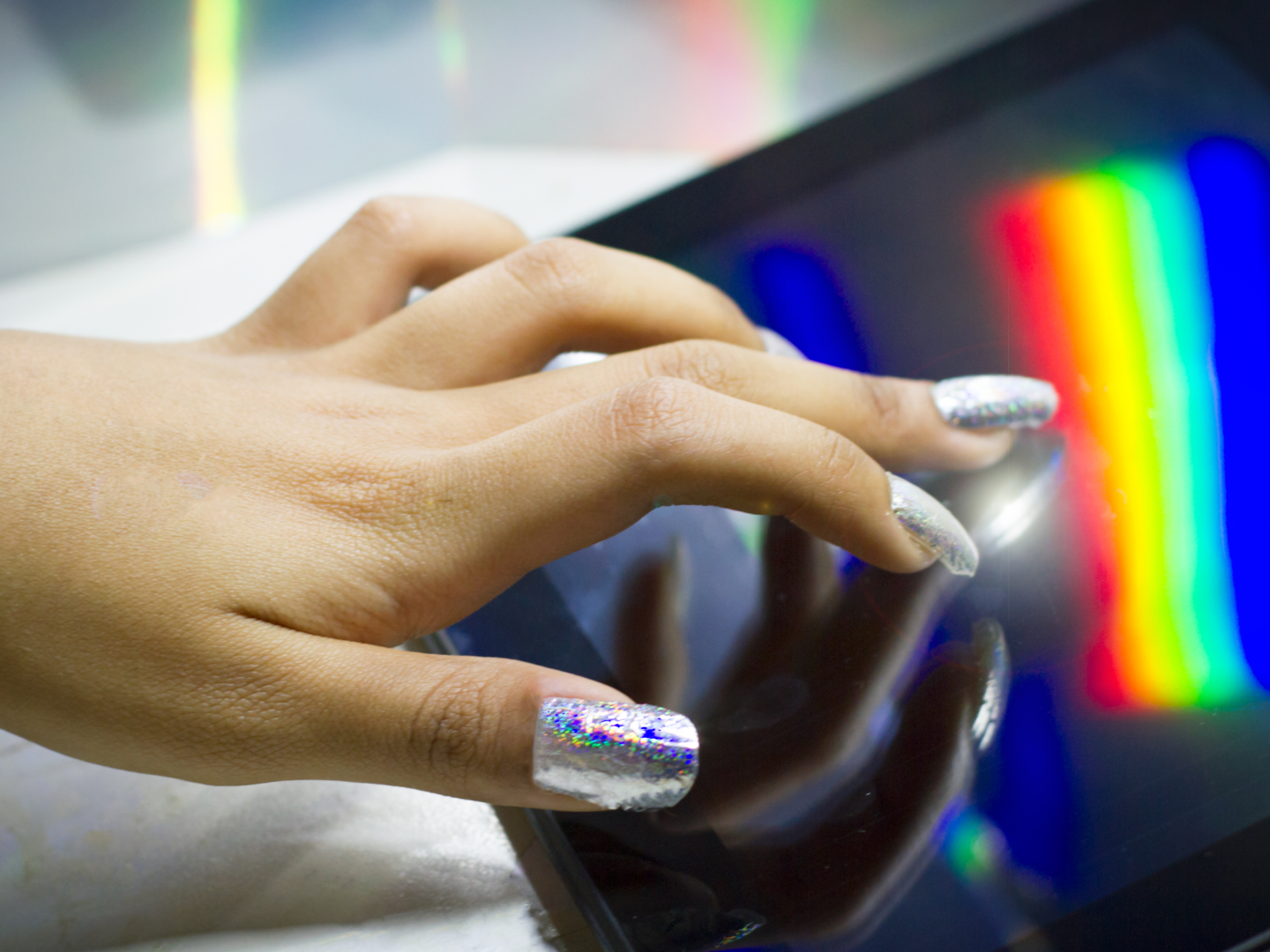
An American chemistry student has successfully developed a prototype of a transparent, electrically conductive nail polish that solves a problem faced by millions worldwide: the inability of touchscreens to respond to long nails or calluses (hardened skin).
The idea originated as a solution to the “zombie finger” problem. Manasi Desai, a student at Centennial College in Louisiana, began her project under the supervision of Associate Professor Joshua Lawrence after observing the difficulties people with long nails, or musicians and carpenters with thick skin on their fingertips, experienced using smartphones.
This phenomenon is technically known as “zombie finger,” where dead skin or calluses prevent the passage of the weak electrical current needed by capacitive screens to register a touch.
A Chemistry Revolution: Protons Instead of Metals
Unlike previous attempts that relied on toxic substances or metallic particles that darkened the nail polish, Desai’s innovation is based on the “chemistry of acids and bases”:
The Magic Ingredients: The student combined the amino acid t-taurine with the compound ethanolamine.
How It Works: Instead of using microscopic metallic wires, the polish relies on the “exchange of protons” between acidic and basic groups on the nail surface. This perfectly mimics the movement of ions in natural human skin, making the screen respond to the nail as if it were a fingertip.
Advantages of the New Innovation
Completely Transparent: It can be applied over any colored manicure or even on natural nails without altering their appearance.
Safe and Healthy: The innovation aims to be completely non-toxic and free of dangerous metallic particles if inhaled.
Versatile: It serves both cosmetic and practical (lifestyle) purposes.
When Will We See It on the Market?
Despite presenting the research at the American Chemical Society’s annual meeting last Monday, the product is not yet ready for sale. Dr. Lawrence explained that the current challenge lies in the “duration of effectiveness”; the coating loses its ability to transmit signals after a few hours or days, while the team is working to make its effect last for weeks.
“We now have a strong proof of concept,” Lawrence added, “but we need more work to improve the final texture and make it as smooth as possible for the fashion world.” The researchers have already filed a provisional patent for this innovation, which could soon change the way we interact with our smart devices.
